Calling Canada's Food Businesses: Are You Ready for Labelling Changes?
There will soon be new legal requirements for front-of-package food labelling in Canada. In this article, NSF's regulatory expert Michelle Anstey explains the changes and, crucially, the urgent action your food business should take to be ready in time.

From January 1, 2026, a new Canadian front-of-package (FOP) labelling regulation comes into force. It means that most prepackaged foods sold in Canada must display an FOP nutrition symbol if they are high in sodium, sugars and/or saturated fat. If you retail your product in Canada – whether you manufacture it there or import it – you need to act fast.
What is the new regulation?
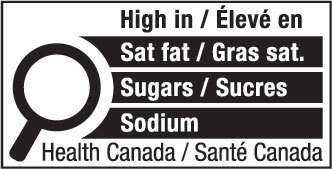
The new FOP labelling regulation stems from amendments by Health Canada to the Food and Drug Regulations in July 2022 to require a standardized magnifying-glass FOP symbol on the principal display panel (PDP) whenever a product meets or exceeds set nutrient thresholds. From January 1, 2026, following a three-and-a-half-year transition period ending on December 31, labels must be compliant, although the Canadian Food Inspection Agency (CFIA), which will enforce the new regulation, will allow products produced/packaged before that date to remain on sale.
Why was it introduced?
The FOP symbol is intended to make at-a-glance nutrition information clear, encouraging healthier food choices by flagging nutrients of public health concern – sodium, sugars and saturated fat. By so doing, it supports Canada’s Healthy Eating Strategy, a government initiative launched in 2016 to improve the nutritional health of Canadians by promoting healthy eating habits and providing them with a supportive food environment. The new regulation also aligns with moves by governments globally to promote clearer FOP food labelling.
Ready to meet Canada’s new FOP labelling requirements?
What food products does it apply to?
Most prepackaged foods for sale in Canada lie within the scope of the new regulation. The FOP rules sit alongside existing labelling requirements, and food businesses are legally obliged to follow them.
But there are some prohibited and fully exempt products.
Prohibited products – foods that must not carry the symbol – include, but are not limited to, infant formula and certain medical foods. Fully exempt products include very small packages with a display surface of less than 15cm1, pure sweetening agents like sugar and maple syrup, salt, milk sold in refillable glass containers and certain shipping and foodservice-only formats.
A third group is 'conditionally exempt', which means you don’t need the FOP symbol unless specified conditions are met. This group includes raw single-ingredient meats and seafood, products containing less than 0.5% alcohol and certain onsite-prepared or very small packages. But such products can lose their exemption, for example, if they no longer meet Nutrition Facts table (NFt) criteria, or if other triggers apply. If those conditions change, you must reassess your product against the new thresholds.
Who needs to comply?
Manufacturers, importers and retailers responsible for labels on prepackaged foods sold to consumers in Canada must adhere to the new regulation.
What does compliance involve?
The FOP symbol is triggered by nutrients of concern – sodium, sugars and saturated fat. It displays three bars that are blank when nutrients do not exceed the threshold, but one, two, or all three may be filled, depending on which nutrients exceed thresholds.
Thresholds are based on their daily value (DV) percentage:
Most foods
The FOP symbol is required at 15% DV or more of the nutrient.
For small reference amounts (30 g/mL or less)
The symbol is required at 10% DV or more.
For main dishes (reference amount 200 g or more for general/170 g or more for children of 1-4 years)
The symbol is required at 30% DV or more.
Critically, you must assess the greater of the product’s serving size or the reference amount (RA). For products with small RAs (30g/mL or less), the 10% DV threshold applies even if your serving size is larger. For saturated fat, you should use the DV for saturated plus trans fat but calculate %DV using saturated fat only (which is different from the NFt calculation).
What are the display rules for the FOP symbol?
Strict rules apply to the display of the FOP symbol, including its format, size, placement and language.
The symbol must be on the principal display panel (PDP) and follow format/size tables in Health Canada's Directory of Nutrition Symbol Specifications. The dimensions can scale with your package’s principal display surface, but a minimum buffer of space around the symbol is required. A horizontal format is typical, but vertical formats are also available and, in some layouts, required.
When it comes to language, Canada’s bilingual labelling rules apply. Health Canada provides bilingual symbol variants and unilingual English and French variants. Depending on your overall label language approach, you have the flexibility to use one bilingual symbol or both unilingual symbols. The Directory includes details of acceptable language options and examples of possible PDP placement.
Does my product need an FOP symbol? Key steps:
- 1Identify the consumer group (children aged one to four only, or general). This determines which DV column applies.
- 2Confirm the product’s RA and serving size then use the greater for calculations.
- 3Calculate %DV for sodium, sugars and saturated fat versus the correct threshold (10%, 15% or 30%).
- 4Check exemptions (full and conditional) and whether any triggers remove a conditional exemption.
- 5Decide symbol content (which nutrients), format, language, size and placement for the PDP.
- 6Document your assessment for audit/retailer queries.2
What should you do first?
Many Canadian food businesses – particularly small and medium-sized enterprises – may still be struggling to come to terms with the new legal requirements for FOP food labelling. If you are among them, don't panic! There's still time to make the necessary preparations. A logical approach, widely endorsed by experts including the Government of Canada and the CFIA, looks something like this:
- 1Start by creating a master list of products and flag those likely to exceed thresholds (salty snacks, cured/processed meats, cheeses, bakery, sauces, meals).
- 2Review the latest formula and nutrition data and run the RA vs. serving-size screen for sodium, sugars and saturated fat (%DV).
- 3Prioritize by volume and risk (placing customer-critical items first).
- 4Decide your symbol strategy (horizontal or vertical; bilingual or two unilingual symbols) and brief your packaging designer on the official Health Canada Directory specifications and artwork).
- 5Reserve placement positioning on the PDP, avoiding clashes with branding and other product information.
- 6Plan inventory, try to use up old stock before the year-end deadline.
- 7Align with your supply chain, building documentation and sharing information with key retail accounts and importers, showing your calculations, exemptions (if any) and placement decisions.
- 8Train your sales and customer service teams to answer consumer and buyer questions about the symbol.
What are the risks of delay?
The CFIA has said it will carry out inspections against the new rules from January 1, 2026. Non-compliant labels can result in you having to take corrective actions, potentially involving costly re-labelling and market disruptions.
Operational risks could include design and print bottlenecks, as packaging lead times become squeezed in the approach to January 1, 2026, with missed deadlines causing costly delays.
Be aware of the risk that retailers may de-list or withhold products that aren’t FOP-compliant.
If you plan to reformulate your product(s) to avoid having to use the symbol (for example, by reducing sugar or salt content), you may risk running out of time to conduct the necessary research and development, including shelf-life and product quality testing.
Where can I access support?
NSF's experts can help you meet the January 1 deadline while avoiding these and many other mistakes, such as:
- Using the serving size when RA is larger.
- Missing the small-RA rule.
- Assuming permanent exemptions – some can be lost.
- Incorrect symbol format/placement.
- Making mistakes in saturated fat calculations.
- Misunderstanding the transition rules.
At NSF, we've seen many such errors, but invariably they can be avoided with guidance from our specialist consultants, who have many years of practical experience in companies' varied labelling requirements. At a higher level, if required, we can perform end-to-end FOP Nutrition Symbol Assessments to relieve you from having to learn the requirements and do the assessments yourself.
What if I export?
Our experts understand food labelling regulations all over the world – so this is another key area where we can offer you specialist support. Canada’s FOP symbol is a domestic requirement. Other markets use different systems. For example, the US does not currently mandate FOP labels – but has a proposal from the US Food and Drug Administration (FDA)3 currently pending – while Mexico and Chile require black octagon warnings on products exceeding their thresholds. If you export prepackaged foods, you must comply with each destination market’s rules separately.
With the new FOP nutrition labelling regulation just a few months away, now is the time to act. Hitting the January 1, 2026, deadline is still achievable – but only if you move quickly and methodically. Above all, act on reliable advice.
Food Label Requirements and Compliance

Food labelling can be a complex territory, especially when preparing products for sale in other countries. Get it right, however, and you could open a world of opportunity for your food and beverage business.
Ready to meet Canada’s new FOP labelling requirements?
What’s New with NSF

NSF Launches Protocol 549 for Glyphosate Reduction Claims
October 14, 2026P549 is the first standard globally that validates glyphosate reduction performance of water filtration systems and products.
Information Systems Security Association (ISSA) Welcomes NSF’s Brian Schultz into the 2026 Hall of Fame
September 10, 2026Lifetime achievement recognition honors exceptional leadership and lasting contributions to the cybersecurity profession.
NSF Welcomes Nicole Parent Haughey to Board of Directors
September 10, 2026NSF's appointment of Nicole supports the organization's continued focus on long-term growth and transformation.
NSF Launches Independent Certification Standard for Compact Products
August 25, 2026New third-party certification verifies products cutting materials and shipping impacts while maintaining safety and performance.