NSF Research Shows Canadians Demand Greater Clarity and Standardization in Food Labeling

Guelph, Ontario – NSF, a leading global public health and safety organization, today released insightful consumer survey data, evaluating Canadians’ perceptions of food labels. Insights showcase a lack of confidence among consumers in food labels, difficulty in interpreting nutritional information and insufficient transparency regarding processing methods, allergens and sustainability.
This data comes as Canada faces its upcoming Front of Package Nutrition Labeling regulation, which is set to be implemented on January 1, 2026. This new regulation was designed to help provide shoppers with hard-to-ignore nutritional information highlighting products that are high in sugar, sodium and saturated fats.
The survey identified gaps beyond what this regulation will provide, with key survey findings including:
- Enhanced labeling demands: 85% of respondents say that detailed processing information would be useful, along with comprehensive allergen information at 83%. Ethical sourcing and the environmental impact score came in at 72% and 70%, respectively.
- Label attention: Overwhelmingly, 90% of 18–34-year-olds are more likely than average to read a product’s label before purchasing a food item. Meanwhile, 66% of respondents pay more attention to food labels compared to five years ago.
- Influence on purchasing behavior: Consumers prioritize reading the expiration date (69%), ingredients list (60%) and nutritional information (57%). They weren’t as likely to read the health claims (33%) or allergen warnings (27%).
- Generational priorities: Across Gen Z, Millennials and Boomers, expiration dates were the most read, jumping from 55% of Gen Z to 80% of Boomers. While allergen warnings ranked the least read, 83% of all adults say that their top priority is clearer allergen labeling, including a thorough list of potential product allergens and cross-contamination during production.
- Label comprehension challenges: A startling one in five consumers struggles to interpret nutritional information, with 31% of consumers failing to understand organic certification, 28% struggling with sustainability claims and 23% with processing methods.
- Sustainability focus: While 71% of respondents say sustainability is an important purchasing consideration for food, only 25% completely understand sustainability claims and only 39% agree that current food labels adequately address sustainability concerns.
- Lack of confidence: Only 9% of adults find health claims very trustworthy. Less than half of adults (48%) rate Canadian food labeling better than labeling in other countries.
“Health and wellness continue to be a focus for most consumers, and with the growing popularity of label-review apps and lack of critical food labeling information in e-commerce, NSF’s research demonstrates that many consumers are reading labels with a more critical eye,” said Michelle Anstey, Regulatory Manager at NSF. “The food industry must respond to these evolving consumer demands, prioritizing more transparent, accessible and reliable labeling practices as regulations are updated and introduced.”
Easy-to-interpret, validated food labeling can help consumers make informed decisions related to diet and well-being. According to Health Canada, one in five adults live with chronic diseases like heart disease, cancer and diabetes. Meanwhile, only one in three Canadians eat enough vegetables and fruit1.
Food labels play a key role in shaping consumer choices and supporting public health. In Canada, labels are being increasingly scrutinized by consumers, the media, government and retailers. NSF supports food manufacturers and retailers with innovative solutions that meet consumer expectations and regulatory labeling requirements. The organization also validates product claims, such as Organic, Vegan, Cruelty-Free, Non-GMO, Gluten-Free, Plant-Based, Raised Without Antibiotics and more, helping businesses to differentiate their products while increasing sales.
“NSF’s consumer survey results point us in the right direction as we revisit and improve food labeling,” added Anstey. “By improving transparency and standardization, we can better communicate with consumers and support a more sustainable, trustworthy food supply chain.”
Learn more about food labeling certifications

About NSF
NSF is an independent, global services organization dedicated to improving human and planet health for more than 80 years by developing public health standards and providing world-class testing, inspection, certification, advisory services and digital solutions to the food, nutrition, water, life sciences and consumer goods industries. NSF has 40,000 clients across all continents and is a World Health Organization (WHO) Collaborating Center on Food Safety, Water Quality and Medical Device Safety.
About the research
NSF commissioned Opinium Research to survey a random sample of 1,000 Canadian consumers in October 2024, weighted to be nationally representative and controlled for gender, age and region.
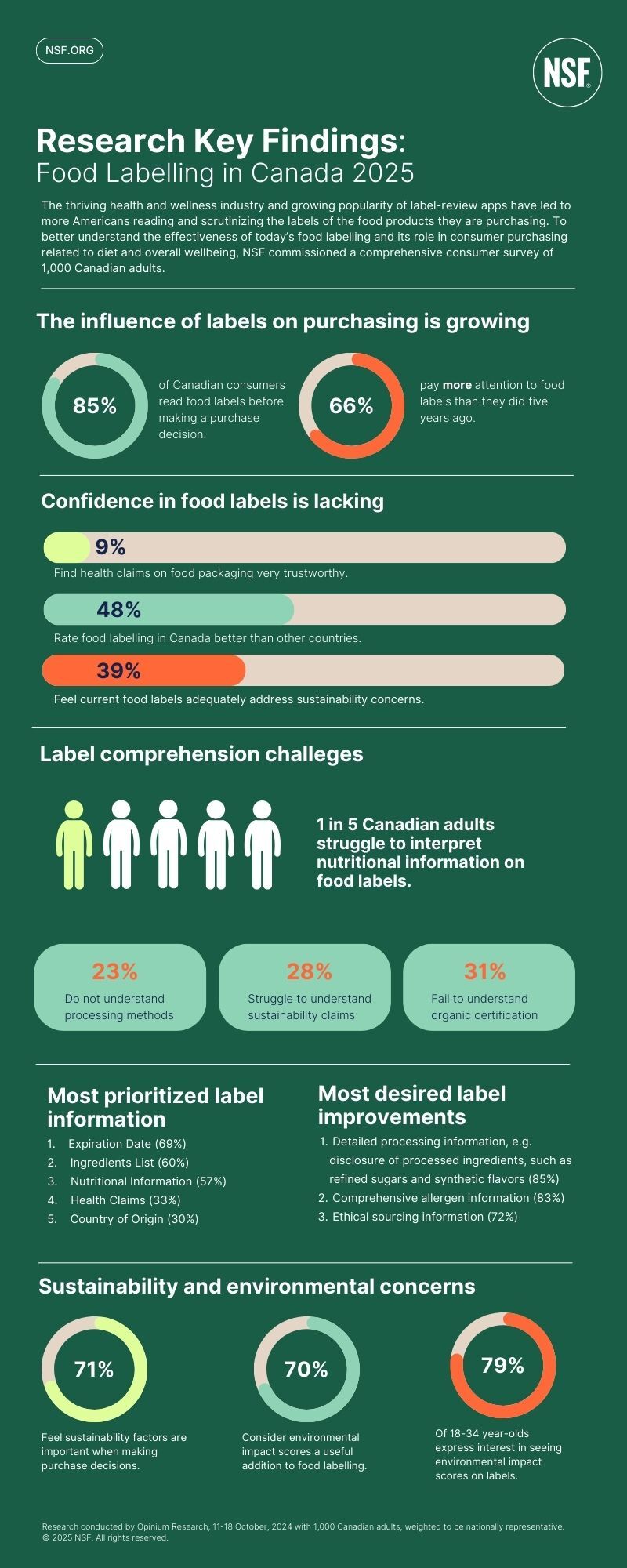
To learn more, read NSF's Future of Canada Food Labelling white paper.
How NSF Can Help You

What’s New with NSF

NSF Launches Protocol 549 for Glyphosate Reduction Claims
October 14, 2026P549 is the first standard globally that validates glyphosate reduction performance of water filtration systems and products.
Information Systems Security Association (ISSA) Welcomes NSF’s Brian Schultz into the 2026 Hall of Fame
September 10, 2026Lifetime achievement recognition honors exceptional leadership and lasting contributions to the cybersecurity profession.
NSF Welcomes Nicole Parent Haughey to Board of Directors
September 10, 2026NSF's appointment of Nicole supports the organization's continued focus on long-term growth and transformation.
NSF Launches Independent Certification Standard for Compact Products
August 25, 2026New third-party certification verifies products cutting materials and shipping impacts while maintaining safety and performance.