Who Is NSF?
From the beginning, NSF set a course to create independent standards and product testing programs to help improve overall public health. NSF has more than 140 currently active public health standards and independent testing protocols. They address products ranging from home water treatment systems to kitchen and household appliances to dietary supplements to sustainable flooring and furnishings.
Today, NSF is a global organization offering services in more than 170 countries. Headquartered in Ann Arbor, Michigan, we remain committed to protecting and improving human health worldwide. We are a Pan American Health Organization/World Health Organization Collaborating Center on Food Safety, Water Quality and Indoor Environment.
We are widely recognized around the world for our scientific and technical expertise in health and environmental sciences. Our microbiologists, engineers, chemists, toxicologists and other environmental professionals are experts in their fields and work hard in our state-of-the-art laboratories to help make sure the products that we all use every day are safer.
Look for the NSF Mark
Around the world, NSF represents technical excellence in public health and safety, and the NSF mark is a symbol of this expertise.
The trusted NSF mark can be found on millions of consumer, commercial and industrial products, including bottled water, dietary supplements, food equipment, home water treatment products, home appliances, plumbing and faucets, and even pool and spa components. This mark is your assurance that the product has been tested by one of the most respected independent certification companies in existence today — NSF. We focus on ensuring public health, safety and environmental quality.
Examples of the NSF Mark
Almost all products that carry NSF certification bear an NSF mark. In some cases the mark appears on the product itself, while in others it might appear on the product packaging or in the literature that accompanies the product.
Options for indicating a product’s certification include the use of just the NSF mark (a circle containing the letters NSF), the letters NSF followed by a series of numbers or letters to indicate a product standard, or a foil sticker with the NSF mark and several numbers/letters that can be traced to a particular manufacturer. In most cases the manufacturer’s name or identifying mark is present on the product along with the product name or model designation.
Below are examples of how the NSF mark may appear on individual products:
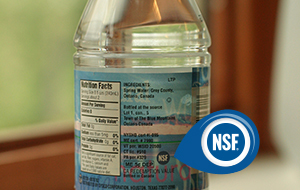
Although voluntary, many manufacturers of NSF certified bottled water use the standard NSF certification mark — a circle containing the letters NSF — as a sign to consumers that their product has been independently tested and certified for quality.
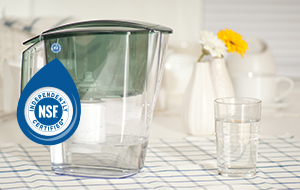
Manufacturers of home water treatment systems frequently use the NSF independently certified mark and indicate the standard(s) to which their product has been certified.
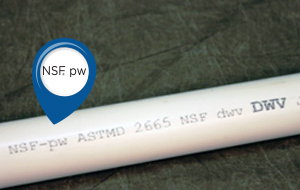
Home plumbing fixtures can bear one of several different marks depending on the type of testing conducted on the product. In this example, “NSF-pw” means that this pipe was certified for potable water use.
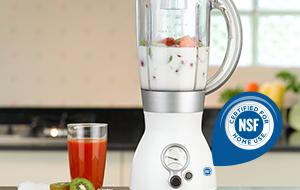
Kitchen appliances and other home products that are certified under NSF’s home products certification program display a special mark on the packaging indicating the product has been certified for home use.

Dietary supplements that have been tested and certified for content under NSF/ANSI 173 display the traditional NSF mark along with a box under the mark to indicate the type of certification received.
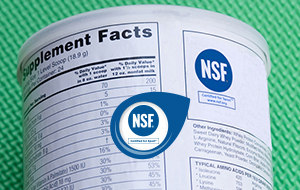
In addition to meeting NSF/ANSI 173, products certified under the NSF Certified for Sport® program bear a unique mark to indicate the product has also been tested for banned substances.
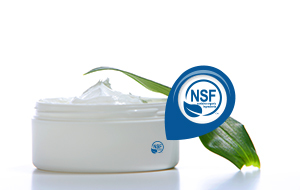
Personal care products that contain at least 70 percent organic content by weight can be reviewed under NSF/ANSI 305 and if compliant, are eligible to bear the mark shown here.
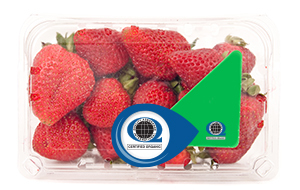
Products that have been certified by Quality Assurance International bear the certification mark shown to the right. QAI certifies that the product meets applicable organic standards in the country where the product is being sold.
How NSF Can Help You

What’s New with NSF

Cambium Analytica, an NSF Company, Opens New Lab in Traverse City, Mich
October 6, 2026Ribbon cutting debuts innovative 15,000-square-foot testing facility to support evolving needs of the food & supplement industries.
NSF Drives Industry Conversations at SupplySide Global 2026 - Las Vegas, Oct. 26–30
September 17, 2026NSF returns to SupplySide Global with expert-led training and trusted certification solutions. Visit Booth 4741 to discover how NSF and Cambium Analytica help brands build trust, increase consumer confidence and stand out in a competitive marketplace.
NSF Welcomes Hanjun Kwon, Managing Director, APAC
September 14, 2026Experienced business leader to drive sustainable growth, organizational development and operational excellence across the Asia-Pacific region.
NSF to Exhibit and Present at PACK EXPO International
September 11, 2026NSF is proud to be part of PACK EXPO International 2026, the premier event bringing together packaging and processing leaders from across industries.